<?xml version="1.0" encoding="UTF-8"?>
<projects type="array">
  <project>
    <category-name>residential</category-name>
    <created-at type="datetime">2008-02-23T20:25:25+00:00</created-at>
    <elements-count type="integer">0</elements-count>
    <id type="integer">16</id>
    <images>&lt;img src="/images/0000/0544/Shaftsbury__6_.jpg" alt="" /&gt;
&lt;img src="/images/0000/0550/Shaftsbury__30_.jpg" alt="" /&gt;
&lt;img src="/images/0000/0499/page_4___axo_diagrams.jpg" alt="" /&gt;
&lt;img src="/images/0000/0556/Shaftsbury__38_.jpg" alt="" /&gt;
&lt;img src="/images/0000/0547/Shaftsbury__28_.jpg" alt="" /&gt;
&lt;img src="/images/0000/0553/Shaftsbury__36_.jpg" alt="" /&gt;
&lt;img src="/images/0000/0466/superkul_40R-Laneway_Ext-01.jpg" alt="" /&gt;
&lt;img src="/images/0000/0484/superkul_40R-Laneway_I-06-LR.jpg" alt="" /&gt;
&lt;img src="/images/0000/0475/superkul_40R-Laneway_I-01-LR.jpg" alt="" /&gt;
&lt;img src="/images/0000/0478/superkul_40R-Laneway_I-02-LR.jpg" alt="" /&gt;
&lt;img src="/images/0000/0298/bw_from_SE.jpg" alt="" /&gt;</images>
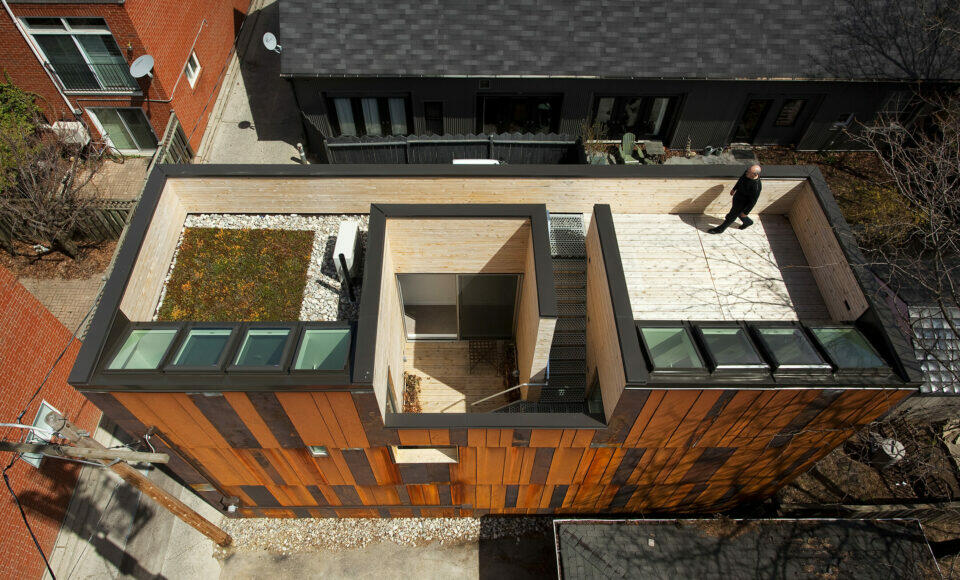
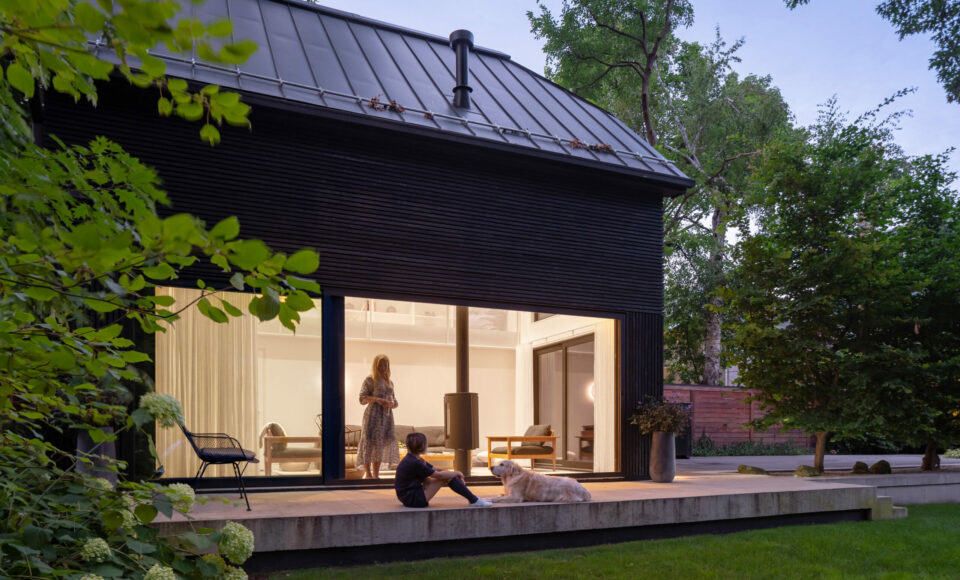
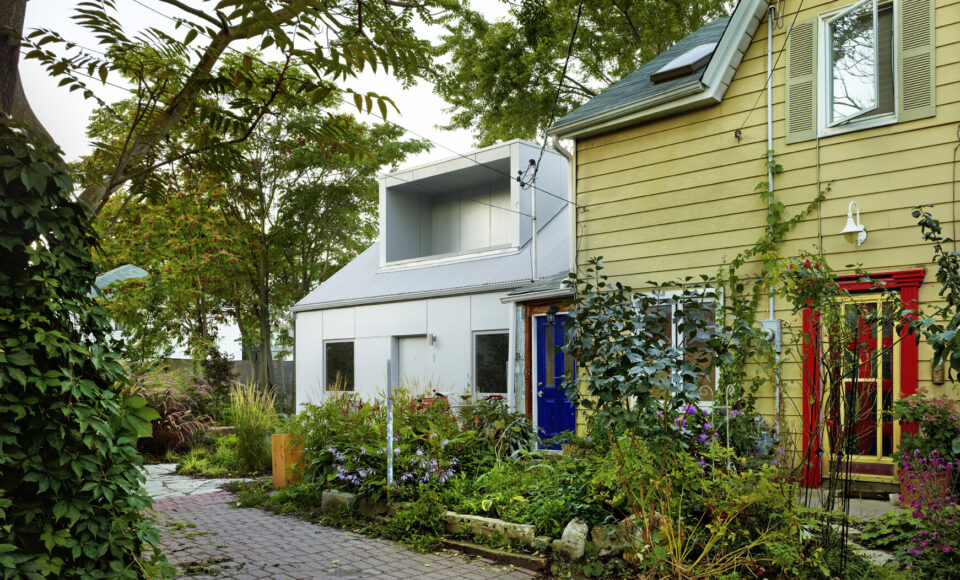
    <info>&lt;p&gt;Once a blacksmith&amp;#8217;s shop, then a horse shed and later an artist&amp;#8217;s apartment and studio, this laneway building in Toronto was purchased by its current owners in 2006. Interested both in the character of the building and smaller footprint living, they wanted to convert it into single-family residence&amp;#8212;while retaining as much of the character of the existing building as possible.&lt;/p&gt;

	&lt;p&gt;Located on a 40&amp;#8217;x18&amp;#8217; lot, it is built to the property lines on 3 sides, with 2&amp;#8217; to spare on the fourth. Current zoning regulations don&amp;#8217;t allow for additional openings in any of the walls, so the design strategy was to draw additional light, air and views from above. A light shaft topped by skylights runs the length of the west wall of the building, broken only by a courtyard on the second floor. The shaft brings light to the ground floor, and provides passive ventilation. On the second floor, a glass and wood wrapped courtyard separates the two bedrooms. From the courtyard, with its primary view to the sky, there is a small stair up to a roof garden.&lt;/p&gt;


	&lt;p&gt;The existing rusted steel cladding panels on the building were catalogued before they were removed. They were then brake-formed with a flat-lock seam and re-installed as the primary building skin. Black-stained knotty cedar clads the remainder of the building.&lt;/p&gt;</info>
    <name>40R_Laneway House</name>
    <permalink>40-r-laneway-house</permalink>
    <photo-credit>Tom Arban (1,2,4,5,6) / superk&#252;l (3,11) / Lorne Bridgman (7-10)</photo-credit>
    <thumbnail>&lt;img src="/images/0000/0544/Shaftsbury__6__thumb.jpg" alt="" /&gt;</thumbnail>
    <updated-at type="datetime">2009-05-08T14:40:57+00:00</updated-at>
  </project>
  <project>
    <category-name>commercial</category-name>
    <created-at type="datetime">2009-02-25T17:03:43+00:00</created-at>
    <elements-count type="integer">0</elements-count>
    <id type="integer">20</id>
    <images>&lt;img src="/images/0000/0514/99_NE-view.jpg" alt="" /&gt;
&lt;img src="/images/0000/0517/99-_SE-view.jpg" alt="" /&gt;
&lt;img src="/images/0000/0508/99_Lounge.jpg" alt="" /&gt;
&lt;img src="/images/0000/0523/99_yoga-studio.jpg" alt="" /&gt;
&lt;img src="/images/0000/0520/99_weight-room.jpg" alt="" /&gt;</images>
    <info>&lt;p&gt;99 Sudbury was a planned 20,000 square foot warehouse renovation and addition. Including a fitness studio, multi-purpose event space, elevated competition squash courts (the &amp;#8216;skycourts&amp;#8217;), a lounge and a terrace, the project was to be built in two phases, each a variation on a single architectonic strategy&amp;#8212;developed to negotiate a balance between the intimately private parts of the club and the club&#8217;s more public and urban aspect.&lt;/p&gt;


	&lt;p&gt;The skycourts act as both a beacon and a look-out point of the new volume, nestled as the club is into the existing residential and industrial fabric north of the rail-corridor and away from the activity of the main streets to the north and south of it. Importantly, the location and relatively discrete construction of the skycourts were designed to minimize the impact of their construction on the on-going operation of the club.&lt;/p&gt;</info>
    <name>99 Sudbury</name>
    <permalink>99-sudbury</permalink>
    <photo-credit>superk&#252;l </photo-credit>
    <thumbnail>&lt;img src="/images/0000/0514/99_NE-view_thumb.jpg" alt="" /&gt;</thumbnail>
    <updated-at type="datetime">2009-05-27T11:42:56+00:00</updated-at>
  </project>
  <project>
    <category-name>residential</category-name>
    <created-at type="datetime">2008-01-31T23:08:31+00:00</created-at>
    <elements-count type="integer">0</elements-count>
    <id type="integer">1</id>
    <images>&lt;img src="/images/0000/0013/annexhouse4.jpg" alt="" /&gt;&lt;img src="/images/0000/0007/annexhouse2.jpg" alt="" /&gt;&lt;img src="/images/0000/0004/annexhouse1.jpg" alt="" /&gt;&lt;img src="/images/0000/0010/annexhouse3.jpg" alt="" /&gt;&lt;img src="/images/0000/0016/annexhouse5.jpg" alt="" /&gt;</images>
    <info>&lt;p&gt;Located in Toronto&#8217;s Annex neighbourhood, this home renovation and addition achieves a subtle balance between a historical cottage and contemporary living&#8212;with an emphasis on livability and natural light. The area is doubled through the addition of a volume to the back of the red brick cottage, providing a subtle contrast with its dark brick skin and its large window openings. The design&#8212;which harmonizes historical renovation and new construction&#8212;was the result of working with both the local historical board and the client to find the correct balance.&lt;/p&gt;


	&lt;p&gt;The interior sequence opens up the full volume of the cottage as an expanded living area, while the kitchen, skylit stair and large openings to the sky find their place in the new addition, with an intimate connection to the garden at the back of the property.&lt;/p&gt;</info>
    <name>Annex House</name>
    <permalink>annex-house</permalink>
    <photo-credit>Tom Arban</photo-credit>
    <thumbnail>&lt;img src="/images/0000/0013/annexhouse4_thumb.jpg" alt="" /&gt;</thumbnail>
    <updated-at type="datetime">2008-04-25T15:48:02+00:00</updated-at>
  </project>
  <project>
    <category-name>residential</category-name>
    <created-at type="datetime">2008-01-31T23:08:31+00:00</created-at>
    <elements-count type="integer">0</elements-count>
    <id type="integer">2</id>
    <images>&lt;img src="/images/0000/0025/crescentroad2.jpg" alt="" /&gt;&lt;img src="/images/0000/0028/crescentroad3.jpg" alt="" /&gt;&lt;img src="/images/0000/0031/crescentroad4.jpg" alt="" /&gt;&lt;img src="/images/0000/0022/crescentroad1.jpg" alt="" /&gt;&lt;img src="/images/0000/0034/crescentroad5.jpg" alt="" /&gt;</images>
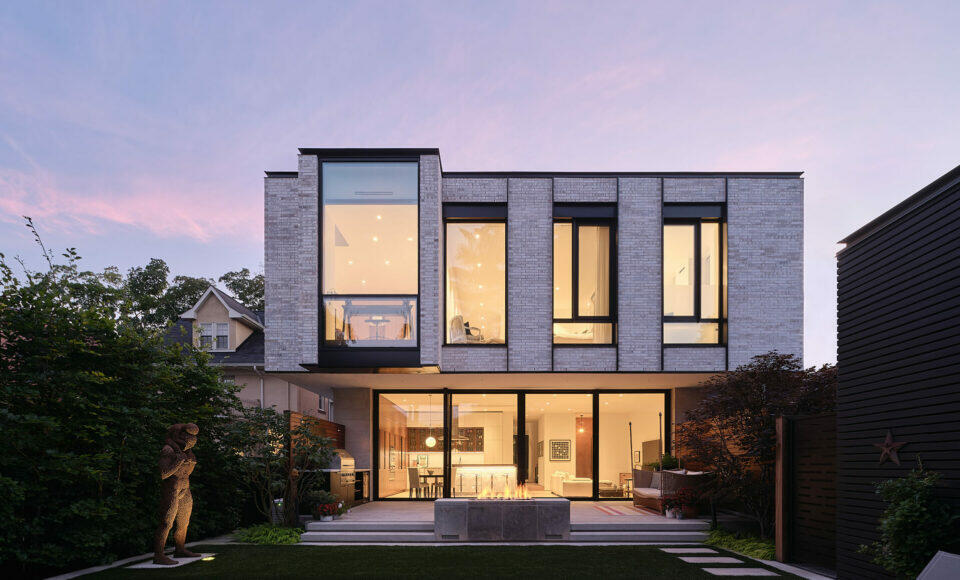
    <info>&lt;p&gt;Located in Rosedale &#8212; a traditional downtown Toronto neighbourhood &#8212; this house reinterprets the materiality and massing of the traditional houses around it. Having raised a family in their first house, the clients now wanted a home in which to scale down, one tailored to their needs and those of an elderly parent.&lt;/p&gt;


	&lt;p&gt;The house opens front and back to the landscape, extending the space of the house outward and bringing the street and landscape in. The social diagram of the house and the needs of its occupants are manifest in its two volumes &#8212; a lower two-storey brick and wood box wraps a higher two-and-a-half-storey atrium at the centre of the plan. This atrium both organizes the plan of the house and washes the interior with light. Astride the atrium, a small lift allows the owners and parent to move easily from one floor to the next.&lt;/p&gt;


	&lt;p&gt;The house was designed to anticipate the clients&amp;#8217; needs as they grow older, a house in which they could live well for the rest of their lives.&lt;/p&gt;</info>
    <name>Crescent Road House</name>
    <permalink>crescent-house</permalink>
    <photo-credit> Edward Addeo and Tom Arban</photo-credit>
    <thumbnail>&lt;img src="/images/0000/0025/crescentroad2_thumb.jpg" alt="" /&gt;</thumbnail>
    <updated-at type="datetime">2008-12-21T19:08:56+00:00</updated-at>
  </project>
  <project>
    <category-name>commercial</category-name>
    <created-at type="datetime">2008-01-31T23:08:31+00:00</created-at>
    <elements-count type="integer">0</elements-count>
    <id type="integer">3</id>
    <images>&lt;img src="/images/0000/0037/distrikt1.jpg" alt="" /&gt;&lt;img src="/images/0000/0040/distrikt2.jpg" alt="" /&gt;&lt;img src="/images/0000/0043/distrikt3.jpg" alt="" /&gt;&lt;img src="/images/0000/0046/distrikt4.jpg" alt="" /&gt;</images>
    <info>&lt;p&gt;Distrikt is a popular 13,000-square-foot club located in the Toronto&#8217;s entertainment district.&lt;/p&gt;


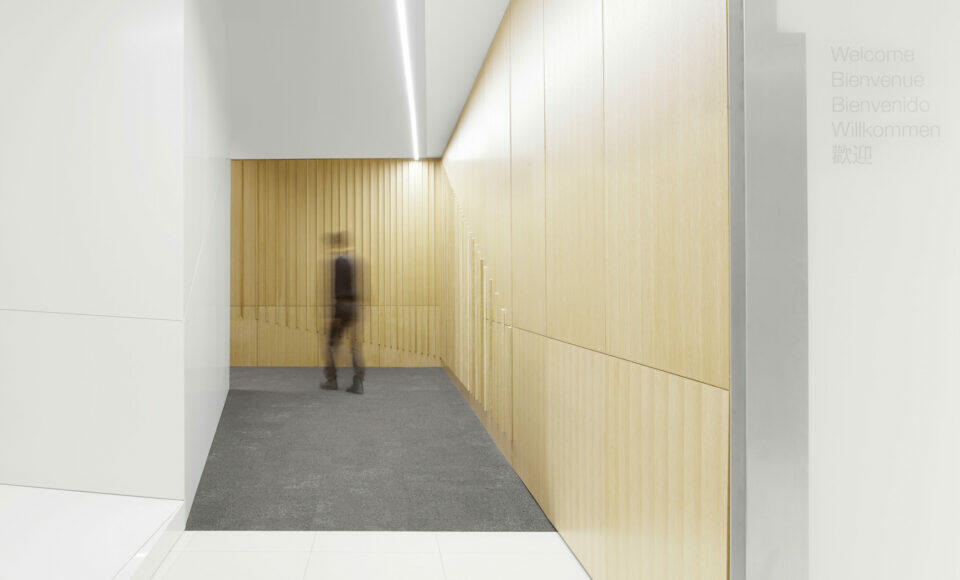
	&lt;p&gt;Built within an existing warehouse shell, the club is less a response to the city around it than it is about the spectacle of people and architecture within. To this end, an attenuated entry sequence &#8212; clubbers descend a wide stair to a long tunnel with slanted walls, punctuated by slivers of light, which leads to the main club space above &#8212; heightens and exaggerates the separation of one world from another.&lt;/p&gt;


	&lt;p&gt;Overscaled design elements &#8211;bars, stairs and the tunnel&#8211; play against the large building shell to distort the clubbers&#8217; spatial and visual sense of the space and create a heightened sense of theatre and spectacle. Raised &lt;span class="caps"&gt;VIP&lt;/span&gt; areas at either end of the main club space contain a large dance floor, presided over by a 7-ft diameter disco ball, and connected by a long walnut bar with a sculpted ceiling hovering above.&lt;/p&gt;


	&lt;p&gt;&lt;i&gt;Interior design consultants: UW Design Group&lt;/i&gt;&lt;/p&gt;</info>
    <name>Distrikt Club</name>
    <permalink>distrikt</permalink>
    <photo-credit>Tom Arban</photo-credit>
    <thumbnail>&lt;img src="/images/0000/0037/distrikt1_thumb.jpg" alt="" /&gt;</thumbnail>
    <updated-at type="datetime">2008-03-11T14:47:08+00:00</updated-at>
  </project>
  <project>
    <category-name>mixed-use</category-name>
    <created-at type="datetime">2008-02-03T22:51:36+00:00</created-at>
    <elements-count type="integer">0</elements-count>
    <id type="integer">6</id>
    <images>&lt;img src="/images/0000/0091/encomium4.jpg" alt="" /&gt;
&lt;img src="/images/0000/0076/encomium0.jpg" alt="" /&gt;
&lt;img src="/images/0000/0085/encomium2.jpg" alt="" /&gt;
&lt;img src="/images/0000/0088/encomium3.jpg" alt="" /&gt;</images>
    <info>&lt;p&gt;This mixed-use project contains both residential and commercial spaces &#8211;a gallery, offices and an apartment&#8211; and was the first of the firm&#8217;s infill projects, one of a wave of revitalization projects that are slowly tranforming Toronto&#8217;s central core.&lt;/p&gt;


	&lt;p&gt;Long a single-family residence, this rowhouse had over the years become embedded in the city&#8217;s expanding entertainment district. The challenge in converting it into a mixed-use building was in overcoming the limitations of the long, narrow footprint typical of this era of row house, with its dark and divided interiors.&lt;/p&gt;


	&lt;p&gt;Key design elements include sunken courts at the front and rear of the building that extend the space of the gallery and the office and book-end the gallery with light. Polished concrete, white oak and white walls create a serene gallery environment of suffused light, ideal for the display of art and photographs.&lt;/p&gt;


	&lt;p&gt;&lt;i&gt;Interior Design consultants: UW Design Group&lt;/i&gt;&lt;/p&gt;</info>
    <name>Encomium</name>
    <permalink>encomium-contemporary-art</permalink>
    <photo-credit>Tom Arban</photo-credit>
    <thumbnail>&lt;img src="/images/0000/0091/encomium4_thumb.jpg" alt="" /&gt;</thumbnail>
    <updated-at type="datetime">2008-03-05T22:21:14+00:00</updated-at>
  </project>
  <project>
    <category-name>commercial</category-name>
    <created-at type="datetime">2008-02-12T22:19:16+00:00</created-at>
    <elements-count type="integer">0</elements-count>
    <id type="integer">14</id>
    <images>&lt;img src="/images/0000/0106/fielding1.jpg" alt="" /&gt;
&lt;img src="/images/0000/0109/fielding2.jpg" alt="" /&gt;
&lt;img src="/images/0000/0112/fielding3.jpg" alt="" /&gt;
&lt;img src="/images/0000/0115/fielding4.jpg" alt="" /&gt;</images>
    <info>&lt;p&gt;Fielding Estate Winery is a small family-run company producing limited batch wines through traditional methods. Located on an 18-acre vineyard atop the Niagara Escarpment in Beamsville, Ontario, the siting and building design maximize arable vineyard and optimize the visitors&#8217; views across the landscape.&lt;/p&gt;


	&lt;p&gt;Two distinct program elements&#8212;a production component and a retail aspect&#8212;resulted in a clear, simple design of a long shed under an open gabled roof, with the retail component overlooking the production areas on the ground floor visually and spatially integrating it with the winemaking process. The shed form speaks to the family&#8217;s agricultural background and their interest in southern Ontario vernacular architecture.&lt;/p&gt;


	&lt;p&gt;The design introduces several sustainable features: a gravity-fed septic system and filter treatment bed; operable high-performance windows, and a central skylight with operable roof vents allowing daylighting and passive ventilation and cooling. A permeable granular drive and a storm water retention pond reduce surface water run-off.&lt;/p&gt;</info>
    <name>Fielding Estate Winery</name>
    <permalink>fielding-estate-winery</permalink>
    <photo-credit>Tom Arban</photo-credit>
    <thumbnail>&lt;img src="/images/0000/0106/fielding1_thumb.jpg" alt="" /&gt;</thumbnail>
    <updated-at type="datetime">2008-11-19T22:24:04+00:00</updated-at>
  </project>
  <project>
    <category-name>residential</category-name>
    <created-at type="datetime">2009-10-02T18:49:05+00:00</created-at>
    <elements-count type="integer">0</elements-count>
    <id type="integer">21</id>
    <images>&lt;img src="/images/0000/0565/88-Glen_01.jpg" alt="" /&gt;
&lt;img src="/images/0000/0574/88-Glen_04.jpg" alt="" /&gt;
&lt;img src="/images/0000/0571/88-Glen_03.jpg" alt="" /&gt;
&lt;img src="/images/0000/0568/88-Glen_02.jpg" alt="" /&gt;
&lt;img src="/images/0000/0577/88-Glen_05.jpg" alt="" /&gt;</images>
    <info>&lt;p&gt;...&lt;/p&gt;</info>
    <name>Glen Road House</name>
    <permalink>glen-road-house</permalink>
    <photo-credit>Tom Arban</photo-credit>
    <thumbnail>&lt;img src="/images/0000/0574/88-Glen_04_thumb.jpg" alt="" /&gt;</thumbnail>
    <updated-at type="datetime">2009-10-02T18:49:05+00:00</updated-at>
  </project>
  <project>
    <category-name>mixed-use</category-name>
    <created-at type="datetime">2008-11-14T23:11:31+00:00</created-at>
    <elements-count type="integer">0</elements-count>
    <id type="integer">19</id>
    <images>&lt;img src="/images/0000/0445/home-gallery_01.jpg" alt="" /&gt;
&lt;img src="/images/0000/0442/home-gallery_02.jpg" alt="" /&gt;
&lt;img src="/images/0000/0448/home-gallery_03.jpg" alt="" /&gt;
&lt;img src="/images/0000/0451/home-gallery_04.jpg" alt="" /&gt;
&lt;img src="/images/0000/0454/home-gallery_05.jpg" alt="" /&gt;</images>
    <info>&lt;p&gt;On a main street west of downtown Toronto, a two-storey commercial-residential building is remade as the live-work headquarters for a young family, in the first of several phases.&lt;/p&gt;


	&lt;p&gt;This first phase included the reconstruction of the front fa&#231;ade and the renovation of the ground floor as a commercial art gallery and office. The owners, one of whom runs the gallery (the other is a writer), live upstairs with their two children. Future phases include the construction of a writing studio and courtyard out back, and the addition of a third floor of additional living space. The project provides a fluid live-work environment for the family, one in which the parenting duties and the demands of work are more easily shared and accommodated.&lt;/p&gt;</info>
    <name>Home/Gallery</name>
    <permalink>home-gallery</permalink>
    <photo-credit>Shai Gil</photo-credit>
    <thumbnail>&lt;img src="/images/0000/0451/home-gallery_04_thumb.jpg" alt="" /&gt;</thumbnail>
    <updated-at type="datetime">2008-11-14T23:41:01+00:00</updated-at>
  </project>
  <project>
    <category-name>mixed-use</category-name>
    <created-at type="datetime">2008-02-04T00:11:41+00:00</created-at>
    <elements-count type="integer">0</elements-count>
    <id type="integer">9</id>
    <images>&lt;img src="/images/0000/0145/home-office_street-front.jpg" alt="" /&gt;
&lt;img src="/images/0000/0133/home-office_offices.jpg" alt="" /&gt;
&lt;img src="/images/0000/0136/home-office_library.jpg" alt="" /&gt;
&lt;img src="/images/0000/0139/home-office_kitchen.jpg" alt="" /&gt;
&lt;img src="/images/0000/0142/home-office_south-terrace.jpg" alt="" /&gt;</images>
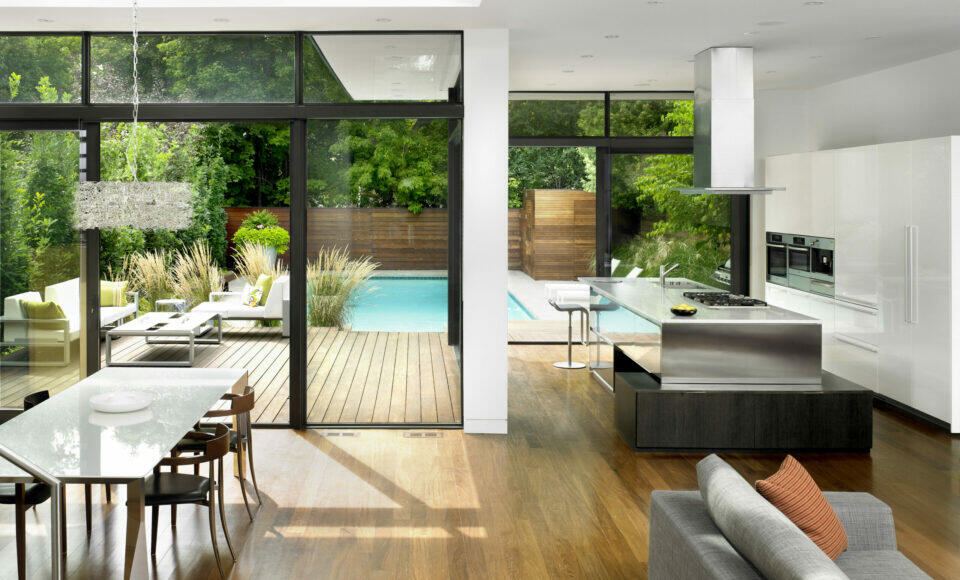
    <info>&lt;p&gt;This project is superk&#252;l&#8217;s most autobiographical project, containing both our home and work environments. The renovation of this main street building reflects the firm&#8217;s values: an interest in infill, enthusiasm for dealing with social community issues by example, the revitalization of the city, the creation of additional density on Toronto&#8217;s main streets, and a strategic approach to urban sustainability.&lt;/p&gt;


	&lt;p&gt;The site was originally occupied by a two-storey building with a shop on the ground floor and an apartment above, in an emerging and under-valued neighbourhood in Toronto&#8217;s west end. Conversion to Home/Office involved its wholesale renovation and the addition of a third floor, creating a studio office on the ground and basement floors and an apartment on the second and third. The massing and height of the building take their cues from adjacent fabric, as do window proportions and heights. Materials evoke those of its commercial and residential neighbours, tying it into the streetscape within a modernist palette and architectural vocabulary.&lt;/p&gt;


	&lt;p&gt;The building is divided almost equally between home and office space but is designed to be flexible, with small changes to the circulation and the partitioning easily resulting in a different proportion of uses.&lt;/p&gt;</info>
    <name>Home/Office</name>
    <permalink>home-office</permalink>
    <photo-credit>Ben Rahn / A-Frame Inc.</photo-credit>
    <thumbnail>&lt;img src="/images/0000/0145/home-office_street-front_thumb.jpg" alt="" /&gt;</thumbnail>
    <updated-at type="datetime">2008-03-22T20:27:23+00:00</updated-at>
  </project>
  <project>
    <category-name>residential</category-name>
    <created-at type="datetime">2008-02-03T23:59:58+00:00</created-at>
    <elements-count type="integer">0</elements-count>
    <id type="integer">8</id>
    <images>&lt;img src="/images/0000/0121/Hycroft_2.jpg" alt="" /&gt;
&lt;img src="/images/0000/0118/Hycroft_1.jpg" alt="" /&gt;
&lt;img src="/images/0000/0124/Hycroft_3.jpg" alt="" /&gt;
&lt;img src="/images/0000/0127/Hycroft_4.jpg" alt="" /&gt;
&lt;img src="/images/0000/0130/Hycroft_5.jpg" alt="" /&gt;</images>
    <info>&lt;p&gt;Created by combining two units in a classic 1950s modernist building in Vancouver, this 20&#8217; x 80&#8217; flat was designed for clients seeking a home better tailored to their more modest space needs after their children left home.&lt;/p&gt;


	&lt;p&gt;The gallery-like sensibility speaks to the owners&#8217; passion for collecting modern art. The design embodies one of the magic tricks of modernist design: how to make clean modern space while all the storage and back-of-house elements &#8220;disappear.&#8221; To this end, much of the ingenuity went into what is not seen: art storage and general storage concealed through pivoting walls, more art storage built into unlikely places like under and behind beds; the study with its built-in Murphy bed is easily converted to a guest room.&lt;/p&gt;


	&lt;p&gt;&lt;i&gt;In collaboration with superk&#252;l architecture Vancouver&lt;/i&gt;&lt;/p&gt;</info>
    <name>Hycroft Towers</name>
    <permalink>hycroft-towers</permalink>
    <photo-credit>Martin Tessler</photo-credit>
    <thumbnail>&lt;img src="/images/0000/0121/Hycroft_2_thumb.jpg" alt="" /&gt;</thumbnail>
    <updated-at type="datetime">2008-12-21T18:53:08+00:00</updated-at>
  </project>
  <project>
    <category-name>institutional</category-name>
    <created-at type="datetime">2008-02-20T00:35:12+00:00</created-at>
    <elements-count type="integer">0</elements-count>
    <id type="integer">15</id>
    <images>&lt;img src="/images/0000/0241/061101_NE-view.jpg" alt="" /&gt;
&lt;img src="/images/0000/0238/061101_interior-view.jpg" alt="" /&gt;</images>
    <info>&lt;p&gt;&lt;b&gt;&lt;i&gt;Currently under construction&lt;/i&gt;&lt;/b&gt;&lt;/p&gt;


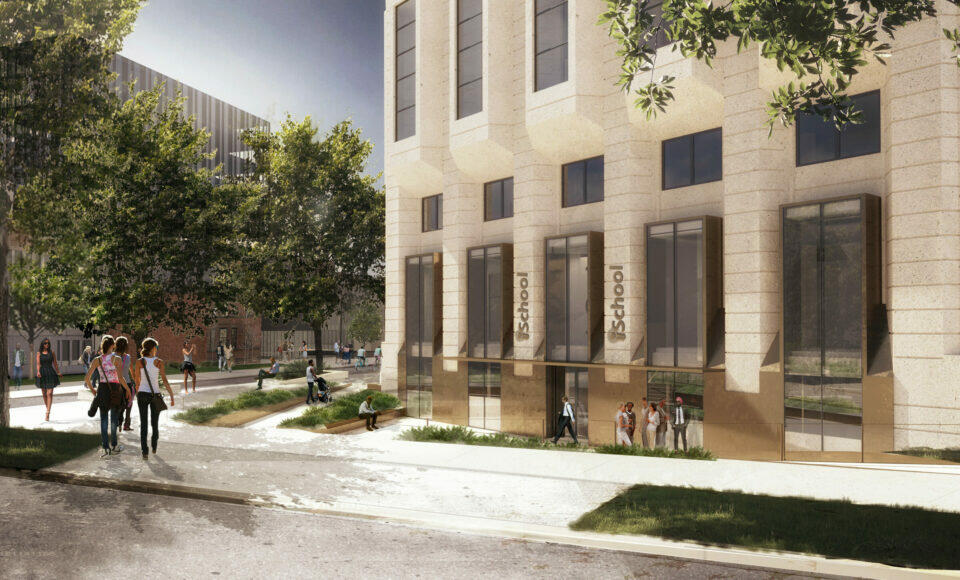
	&lt;p&gt;This 20,000 SF building will be the new home for a small private elementary school previously housed in an old town hall.&lt;/p&gt;


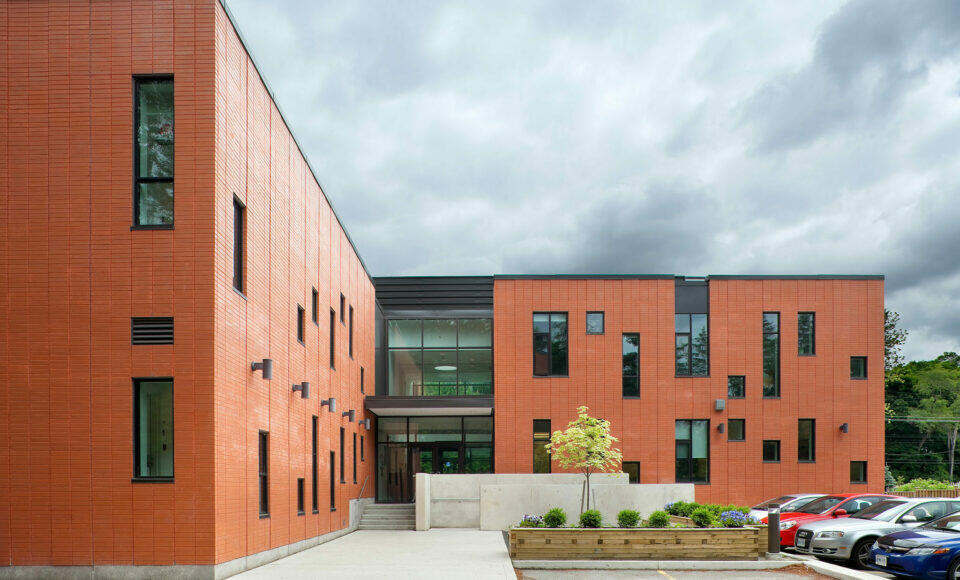
	&lt;p&gt;Of deep red brick and with dark-bronze anodized window frames, the building makes reference both to its residential context and vernacular school architecture in Ontario. The windows are playfully distributed on the facade, positioned so that views of the trees both on site and in the neighbourhood are framed.&lt;/p&gt;


	&lt;p&gt;A small double-height entry lobby is washed with light from tall windows and a skylight, and acts as the centre of the cross-axial plan.&lt;/p&gt;


	&lt;p&gt;Renderings by Don Collins / superk&#252;l inc | architect&lt;/p&gt;</info>
    <name>Junior Academy</name>
    <permalink>junior-academy</permalink>
    <photo-credit>n/a</photo-credit>
    <thumbnail>&lt;img src="/images/0000/0241/061101_NE-view_thumb.jpg" alt="" /&gt;</thumbnail>
    <updated-at type="datetime">2008-02-20T15:53:29+00:00</updated-at>
  </project>
  <project>
    <category-name>master-plan</category-name>
    <created-at type="datetime">2008-03-10T03:34:46+00:00</created-at>
    <elements-count type="integer">0</elements-count>
    <id type="integer">18</id>
    <images>&lt;img src="/images/0000/0316/Option_2_View_1_copy.jpg" alt="" /&gt;
&lt;img src="/images/0000/0322/art_barn___art_barns.jpg" alt="" /&gt;
&lt;img src="/images/0000/0325/orchard___art_court.jpg" alt="" /&gt;</images>
    <info>&lt;p&gt;This master plan for a large residential property in southern Ontario focussed on long term planning options for the environmental stewardship and selective architectural additions to the property.&lt;/p&gt;</info>
    <name>Rockland Master Plan</name>
    <permalink>rockland-master-plan</permalink>
    <photo-credit>n/a</photo-credit>
    <thumbnail>&lt;img src="/images/0000/0316/Option_2_View_1_copy_thumb.jpg" alt="" /&gt;</thumbnail>
    <updated-at type="datetime">2008-03-10T03:35:21+00:00</updated-at>
  </project>
  <project>
    <category-name>residential</category-name>
    <created-at type="datetime">2008-03-08T23:40:52+00:00</created-at>
    <elements-count type="integer">0</elements-count>
    <id type="integer">17</id>
    <images>&lt;img src="/images/0000/0394/Parry_Sound_Cottage_36232.jpg" alt="" /&gt;
&lt;img src="/images/0000/0397/Parry_Sound_cottage__36_.jpg" alt="" /&gt;
&lt;img src="/images/0000/0388/Parry_Sound_cottage_6125_alternate2.jpg" alt="" /&gt;
&lt;img src="/images/0000/0415/Parry_Sound_cottage_6426.jpg" alt="" /&gt;
&lt;img src="/images/0000/0391/Parry_Sound_cottage_6418.jpg" alt="" /&gt;
&lt;img src="/images/0000/0400/Parry_Sound_cottage__53_.jpg" alt="" /&gt;
&lt;img src="/images/0000/0409/Parry_Sound_cottage__72_.jpg" alt="" /&gt;
&lt;img src="/images/0000/0403/Parry_Sound_cottage__75_.jpg" alt="" /&gt;</images>
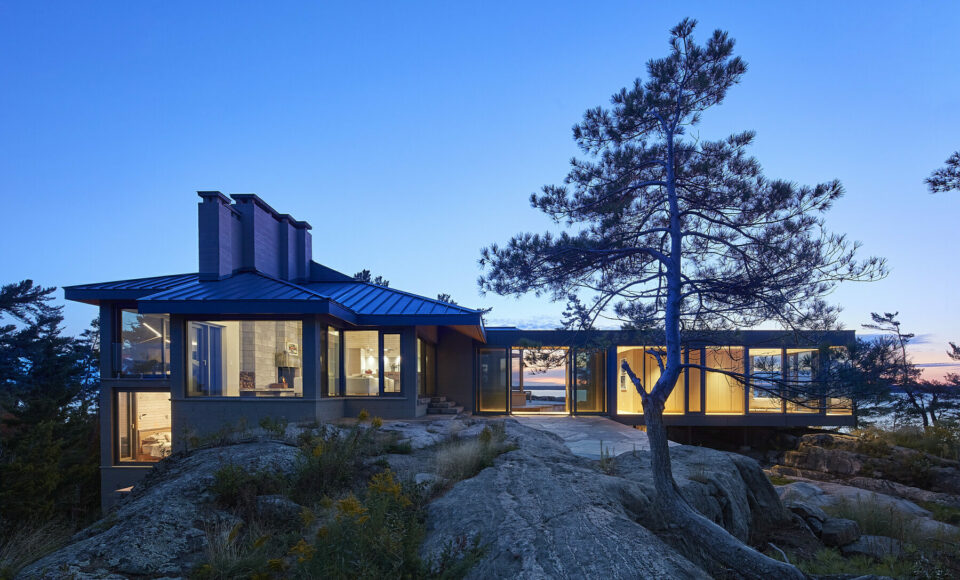
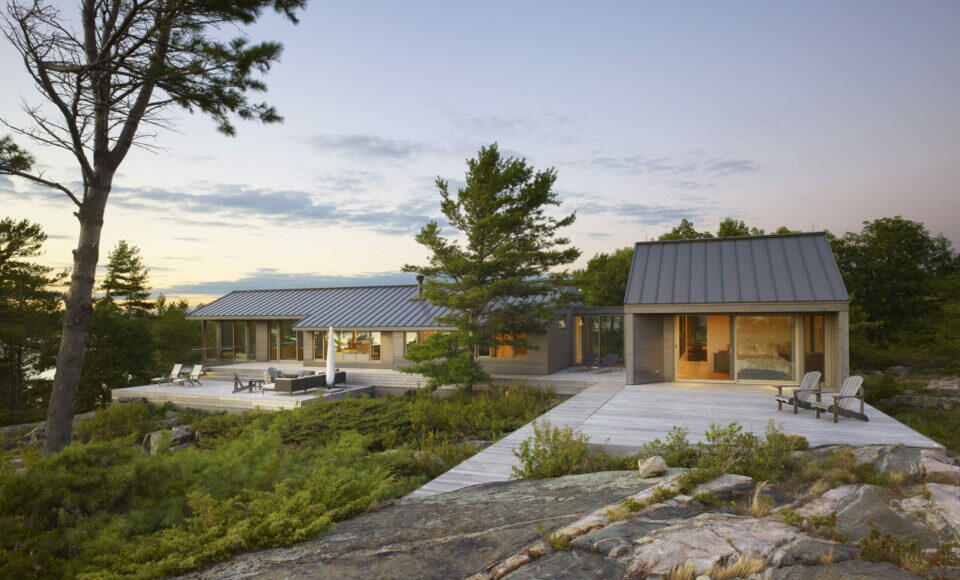
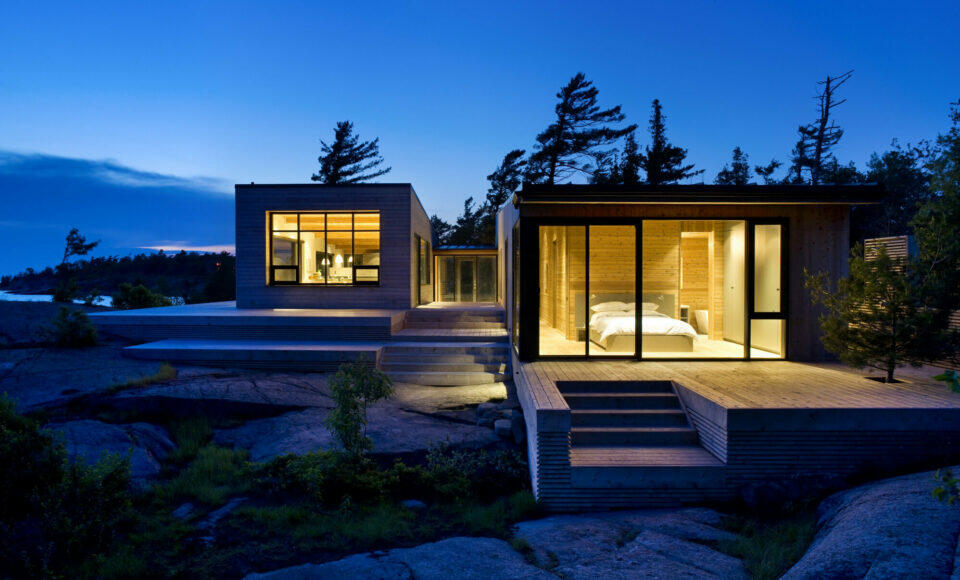
    <info>&lt;p&gt;The site for this 2000-square-foot family cottage on an island in Georgian Bay was chosen for its topography and orientation. Nestled into the exposed, washed granite of the island and against a line of trees, the cottage is sheltered against the strong winds off of the water.&lt;/p&gt;


	&lt;p&gt;The graphic lines of the cottage are designed to further marry it to its site&#8212;highlighting through contrast the wind-sculpted trees and craggy rock of the Bay that make its landscape unique.&lt;/p&gt;


	&lt;p&gt;A glass link bridges between the cottage&#8217;s two volumes&#8212;one containing living spaces, the other sleeping and washing areas&#8212;and a wood deck terraces down to fold into the island on three sides.&lt;/p&gt;


	&lt;p&gt;Window openings throughout are aligned to allow through views to the trees behind and the open water in front. The pure forms of the cottage are highlighted and reinforced through material choice, including knotty cedar cladding, a standing seam metal roof, and a dry-laid stone fireplace.&lt;/p&gt;</info>
    <name>SHIFT Cottage</name>
    <permalink>shift-cottage</permalink>
    <photo-credit>Tom Arban</photo-credit>
    <thumbnail>&lt;img src="/images/0000/0403/Parry_Sound_cottage__75__thumb.jpg" alt="" /&gt;</thumbnail>
    <updated-at type="datetime">2008-10-31T22:38:02+00:00</updated-at>
  </project>
  <project>
    <category-name>institutional</category-name>
    <created-at type="datetime">2010-02-07T01:26:36+00:00</created-at>
    <elements-count type="integer">0</elements-count>
    <id type="integer">22</id>
    <images>&lt;img src="/images/0000/0613/superkul_Sid-Smith_WEB-06.jpg" alt="" /&gt;
&lt;img src="/images/0000/0598/superkul_Sid-Smith_WEB-01.jpg" alt="" /&gt;
&lt;img src="/images/0000/0595/superkul_Sid-Smith_WEB-00.jpg" alt="" /&gt;
&lt;img src="/images/0000/0616/superkul_Sid-Smith_WEB-04.jpg" alt="" /&gt;</images>
    <info>&lt;p&gt;The presence and identity of the University of Toronto&amp;#8217;s Linguistics Department within the larger floor plate is established through this renovation as a warmer, more open and dynamic face with the construction of a new screen for the staff and student lounges, delivered on a very tight budget and timeline.&lt;/p&gt;


	&lt;p&gt;The new oak screen has alternating panels of glass and pin-up board, onto which are grafted 7&#8217; tall letters spelling the word &#8216;Linguistics&#8217;. The screen opens up views to the outside, visually expanding and bringing natural light into the corridor. It also allows for glimpses into the new lounges, creating a connection between the public and semi-public realms and animating the long corridor.&lt;/p&gt;


	&lt;p&gt;Linguists regard language as a system which makes &#8216;infinite use of finite means&#8217;. A statement which applies to both the process of constructing space through architecture and the process of constructing meaning through language, we took this as the basis of our approach. The large graphic lettering plays on the idea that &#8216;text&#8217; does not become &#8216;words&#8217; until we give it meaning. As such, the viewer sees pieces of the word &#8216;linguistics,&#8217; broken and abstracted depending on its material, and infers meaning from it. Furthermore, the large coloured Forbo panels function as bulletin boards, allowing the new fa&#231;ade to act as a communication interface, and adding yet another layer to the concept.&lt;/p&gt;</info>
    <name>Sidney Smith Hall</name>
    <permalink>sidney-smith-hall-renovation-university-of-toronto</permalink>
    <photo-credit>Tom Arban</photo-credit>
    <thumbnail>&lt;img src="/images/0000/0601/superkul_Sid-Smith_WEB-02_thumb.jpg" alt="" /&gt;</thumbnail>
    <updated-at type="datetime">2010-02-07T01:39:25+00:00</updated-at>
  </project>
  <project>
    <category-name>commercial</category-name>
    <created-at type="datetime">2008-02-04T00:22:22+00:00</created-at>
    <elements-count type="integer">0</elements-count>
    <id type="integer">10</id>
    <images>&lt;img src="/images/0000/0154/st-jospehspine1.jpg" alt="" /&gt;
&lt;img src="/images/0000/0157/st-jospehspine2.jpg" alt="" /&gt;
&lt;img src="/images/0000/0151/st-joseph_stair.jpg" alt="" /&gt;
&lt;img src="/images/0000/0148/st-joseph_entry.jpg" alt="" /&gt;</images>
    <info>&lt;p&gt;St. Joseph Media is a large media company with over 350 employees. It publishes several popular Canadian magazines, which were previously housed in several different locations.&lt;/p&gt;


	&lt;p&gt;The site was five existing 19th-century warehouse buildings on the east side of Toronto. The design objective was to create a unified space within, one that allowed each of the magazines to retain its identity. Pockets formed by the buildings&#8217; thick masonry walls were used to create homes for each magazine, while a double-height, skylit spine socially and functionally unites the magazines into a single entity. This tall spine operates like a street, on which the individual magazines have an address and shared meeting rooms, reception and administration space, and a large staff lunch room and outdoor deck overlooking the city.&lt;/p&gt;


	&lt;p&gt;A dramatic axial view greets visitors arriving at the interior street from the elevator. New insertions&#8212;patterned glass in the atrium, felt partitions, coloured acrylic staircases&#8212;create a sleek counterpoint to the raw exposed brick and wood of the original warehouse.&lt;/p&gt;


	&lt;p&gt;&lt;i&gt;In association with Teeple Architects Inc.&lt;/i&gt;&lt;/p&gt;</info>
    <name>St Joseph Media</name>
    <permalink>st-joseph-media</permalink>
    <photo-credit>Tom Arban</photo-credit>
    <thumbnail>&lt;img src="/images/0000/0154/st-jospehspine1_thumb.jpg" alt="" /&gt;</thumbnail>
    <updated-at type="datetime">2009-03-25T23:59:38+00:00</updated-at>
  </project>
</projects>